
How Montelink built a services marketplace for advisors and business experts on Mercur
B2B2C online consultation marketplace for independent advisors and business experts, with a per-minute billing engine and custom expert panel.
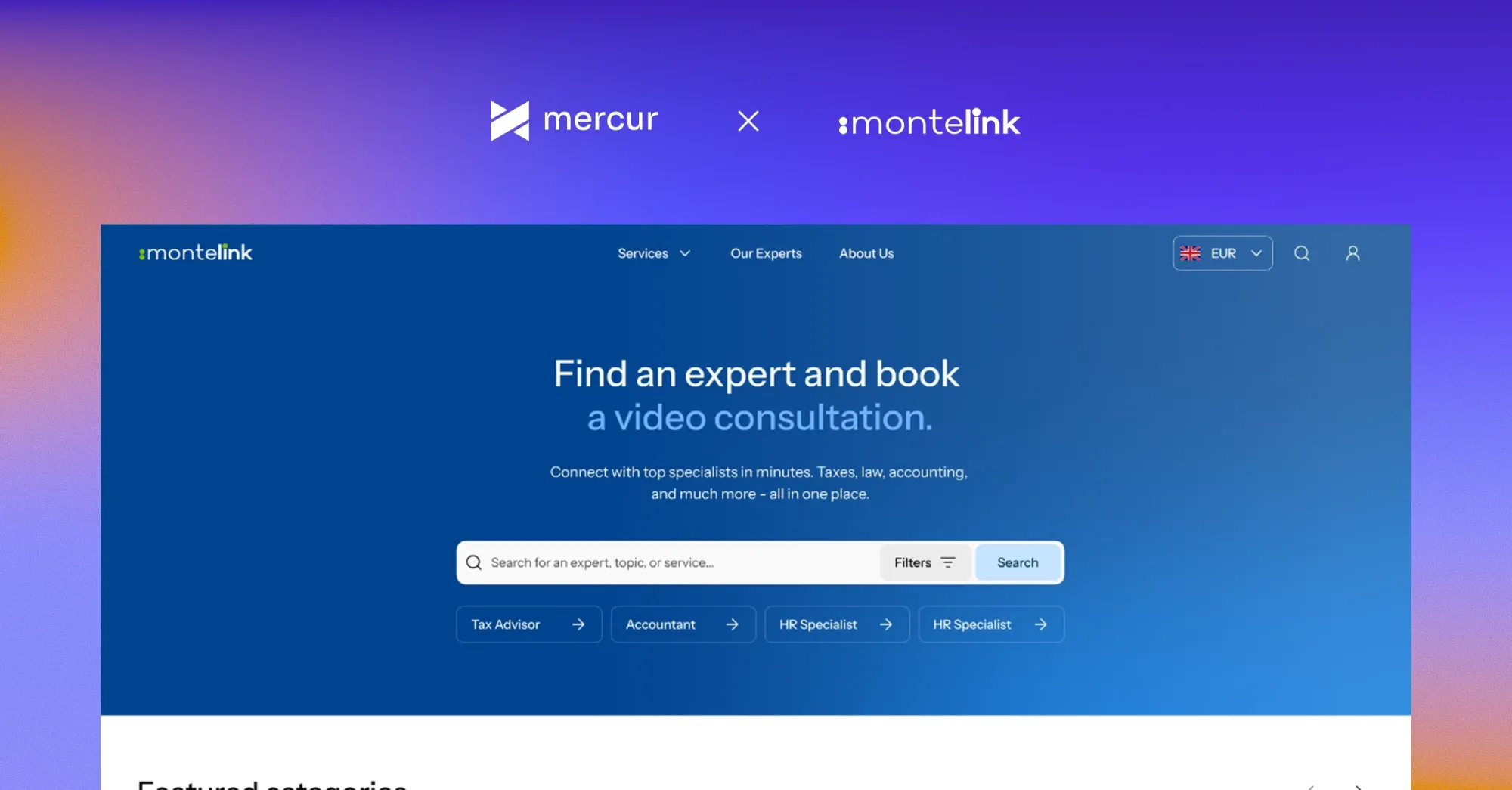
About the marketplace
Montelink is a Polish B2B2C marketplace where independent advisors and business experts sell online consultations directly to clients.
A buyer books a block of an advisor's time, meets them over video, and pays for the booked block plus any extra minutes the session runs. The per-minute rate is shown before booking. Each advisor keeps a public profile with certificates clients can view, sets their own availability and pricing, and continues to run a practice outside the platform.
Advisors pay a recurring subscription for platform access, and a 5% transaction fee comes off every paid order.
The marketplace covers multiple areas of business support, with dozens of categories and support for several languages and currencies.
Highlights
- Per-minute billing settled after the session
- Automated payouts to independent advisors
- Real-time booking with calendar sync
Challenge
Booking a consultation with an advisor or business expert usually means no price up front, a wait for someone to call you back, and forms to fill in before anyone answers your question.
An independent advisor who wants to sell that advice online assembles the machinery alone. One tool takes bookings, a second takes money, a third gets them found. None of the three knows about the others, and the advisor is the integration between them.
A marketplace closes both gaps in one move. It only works if the platform underneath can transact what is being sold. What sells here is a booked block of somebody's time, with any extra minutes charged at the advisor's per-minute rate.
5 things a standard commerce platform couldn't do
Five problems had to be solved before that marketplace could take a single booking.
1. Billing a session whose length is unknown at checkout
A commerce platform attaches a price to a product before checkout. A consultation earns its final price when the meeting ends, and a client who buys 30 minutes may talk for 55.
That requires session duration to be tracked live, compared against the block already paid for, and any extra minutes charged once the call closes. Fixed-price products cannot approximate it, and manual invoicing stops working the moment more than a handful of advisors are selling.
2. Splitting payments and calculating VAT on cross-border sales
Advisors on Montelink are independent professionals and businesses. A client's payment has to reach the right one of them, at the right commission, without each advisor operating payment infrastructure of their own.
EU tax rules sit on top of that. Consultations sold across borders are subject to EU VAT rules that differ for business and consumer clients, so the applicable rate has to be determined per transaction. The calculation has to be recorded per sale.
3. Taking a commission out of a client's payment
Every client payment for an advisor's services or products is money owed to that advisor. The platform's commission has to come out of it automatically on each paid order.
The advisor has to see: what the buyer paid, what the platform took, what is left to pay out. A seller who cannot check those figures stops trusting the platform.
4. Keeping availability with advisor's own calendar
An advisor's slot can look free on Montelink and already be taken elsewhere. The double booking that follows costs the platform its credibility with the client and the advisor at once.
Availability had to move in both directions: outside commitments close slots on Montelink, and Montelink bookings appear in the advisor's own calendar.
5. Creating, delivering, and logging the video session
On a consultation marketplace, the meeting is the product. Emailing a link and trusting both parties to arrive puts the delivered service outside the system that is supposed to bill for it.
The platform had to create each meeting, place it in both calendars, and remind both sides before it starts. It also had to tie the meeting that happened back to the booking record.
Why Mercur
80% of the features already existed
Building from scratch would have meant writing the catalogue, cart, checkout, orders, onboarding, and multi-vendor layer first, before creating the features that fit Montelink's business case.
Those parts arrived out-of-the-box, so development time went into custom modules: billing by duration, the advisor panel with certificate upload, and a catalogue that carries consultations, webinars, and e-books at once.
The platform belongs to Montelink
With Mercur, Montelink owns the platform. There are no licence fees and no percentage of each transaction leaving for a marketplace vendor as volume grows. The cost of the platform does not scale with its success.
Flexible architecture for the custom build
Mercur is a complete marketplace engine, and anything specific to Montelink is added as a separate module.
The consultation logic has its own data model and uses the marketplace through the engine's own interfaces. The engine's code was not changed to add it, so Montelink can move to a new version of Mercur without redoing the custom work.
How Mercur was used
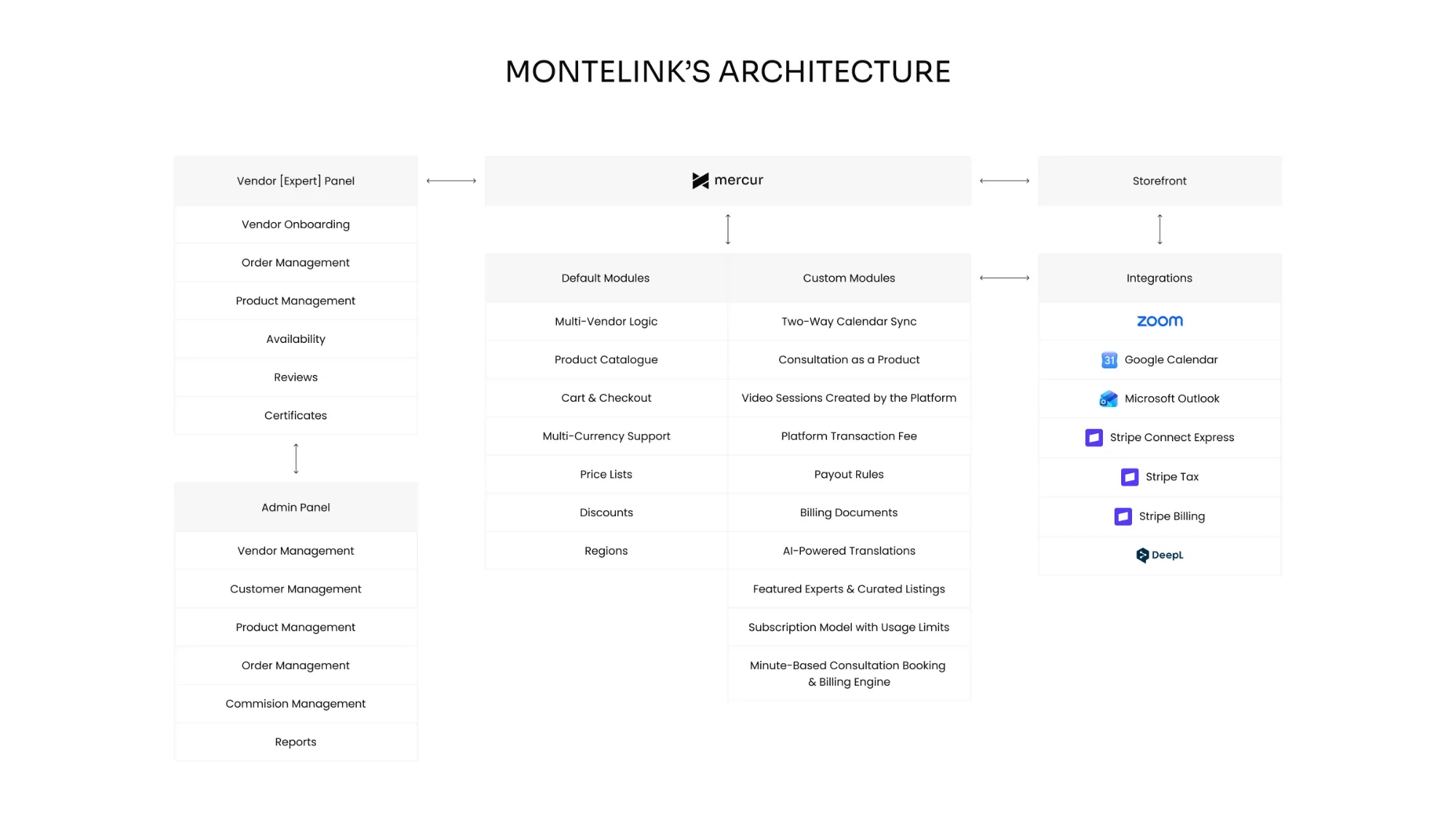
Multi-vendor logic
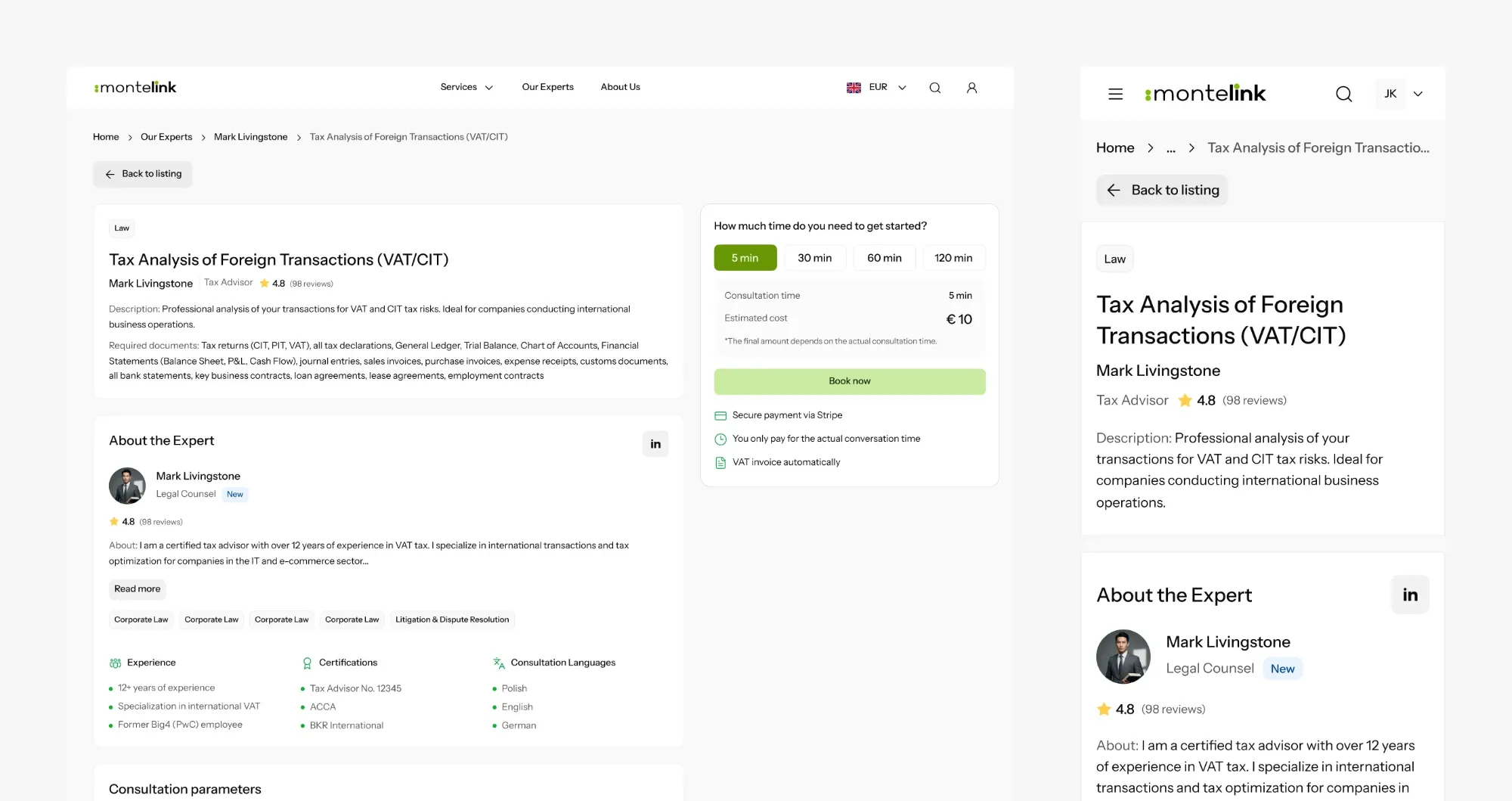
Every advisor is a seller in their own right, managing their own profile. Their services go into one shared catalogue, so a category page shows listings from several advisors next to each other. A buyer comparing advisors sees prices, availability, and certificates side by side, and picks between them on one screen.
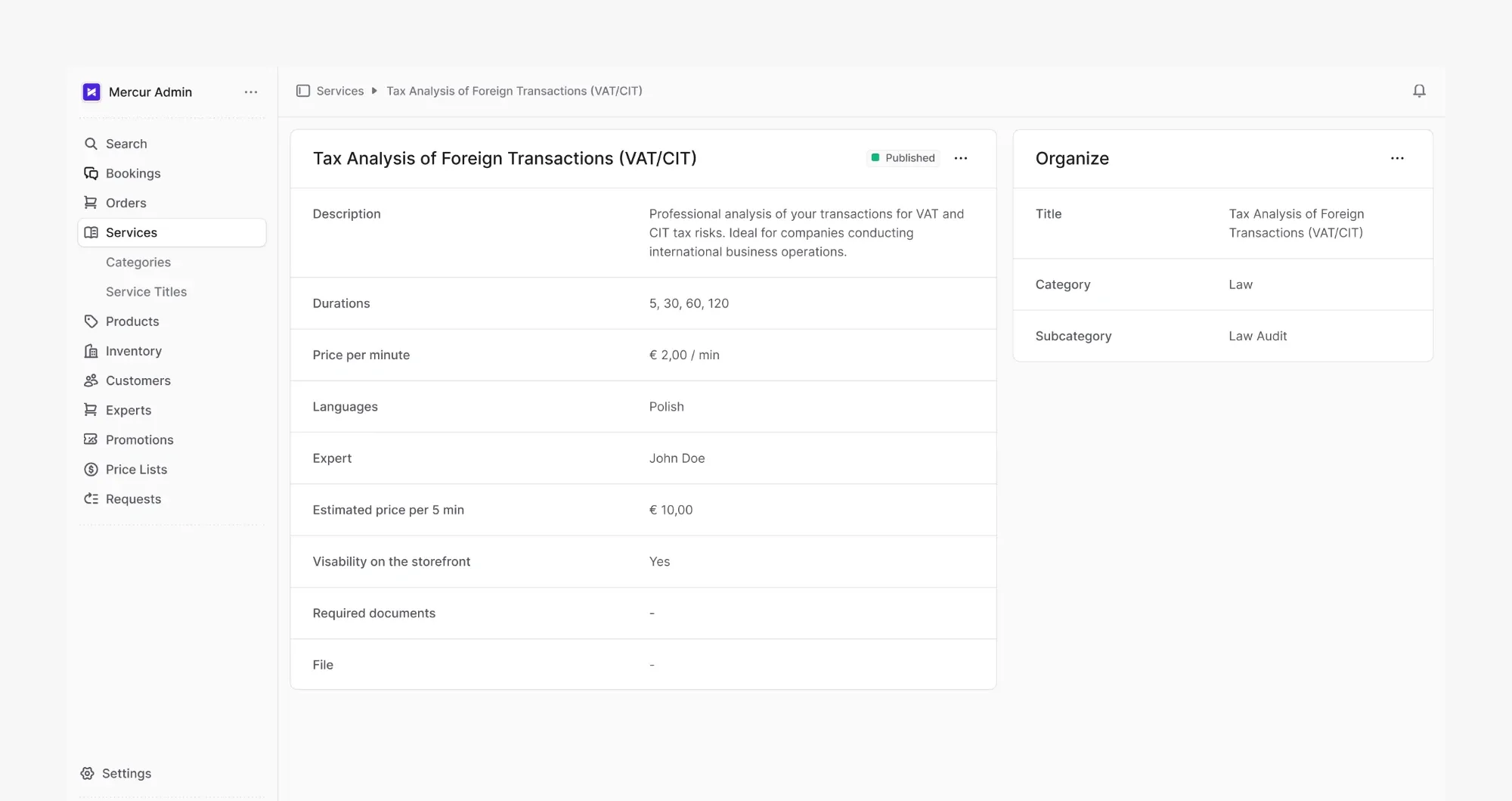
Admin panel
Montelink runs the whole marketplace from this panel: approving advisor registrations, checking a client's history, editing a listing, chasing an order, pulling a report. An admin panel is months of work that no buyer ever sees, and in Mercur it stood ready from the start.
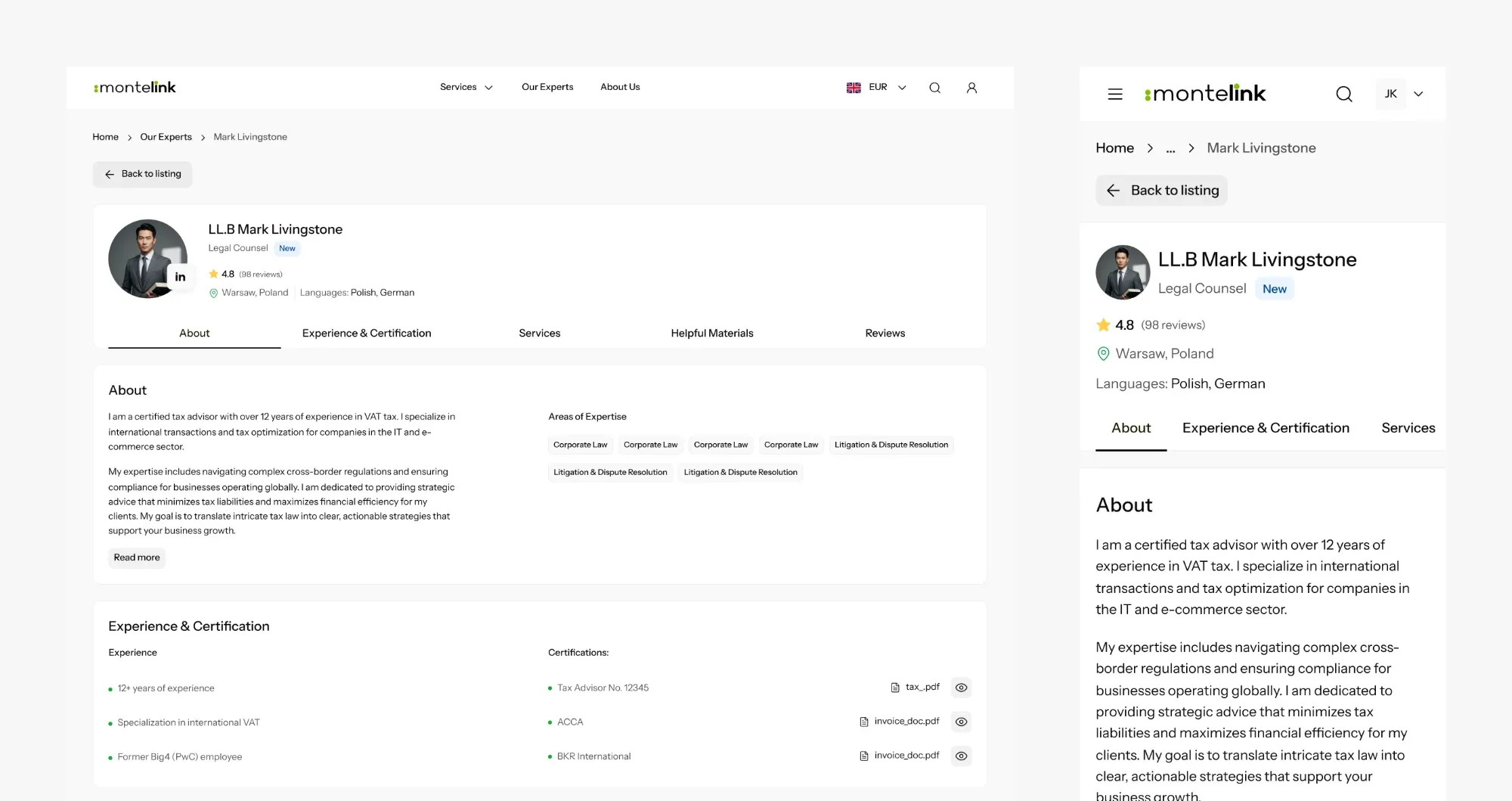
Storefront
Mercur provides a B2C marketplace storefront that Montelink used and restyled to its design. It arrives with category navigation, search and filtering, listing and detail pages, seller profiles, the cart, and the checkout. Layout, typography, and colour follow their brand, and the logic underneath stayed the same as the one the platform provides.
Product catalogue
One catalogue carries three kinds of products offered by independent experts. Paid consultations, seats at webinars, and downloads such as e-books all sit in it, grouped into verticals and categories, and one cart takes any combination.
Cart and checkout
One cart holds products of different types from different sellers at once. A consultation with one advisor, a webinar seat from a second, an e-book from a third. The buyer pays once, and checkout splits that payment by seller so each advisor is credited for their own line.
Multi-currency support
Prices and payouts work in more than one currency. An advisor quotes in their own currency, and a buyer in another country pays in theirs, which is what makes selling across borders possible without a second storefront.
Price lists
Rates are held per seller, so each advisor sets what their own time costs. A single price list across the marketplace would break this model at once. A senior tax adviser and a junior HR consultant charge different amounts for the same thirty minutes, and both figures have to live in the catalogue at the same time.
Discounts
Codes and promotions come with the engine. Montelink can run a first-consultation offer or a campaign code without modifying the billing engine.
Regions
A region ties a country to its currency and its tax treatment. The work of entering a market sits in configuration, where a marketplace planning to expand needs it.
How Mercur was customized
Billing by the minute
The booked block and any extra minutes determine the price. Checkout sells a block of time, the engine follows the live session, and anything past that block is charged after the call ends. Advisors set a per-minute rate for their time. No order comes into existence until the card charge succeeds, so a paid consultation cannot be booked on a declined card.
Platform fee, payout rules, and billing documents
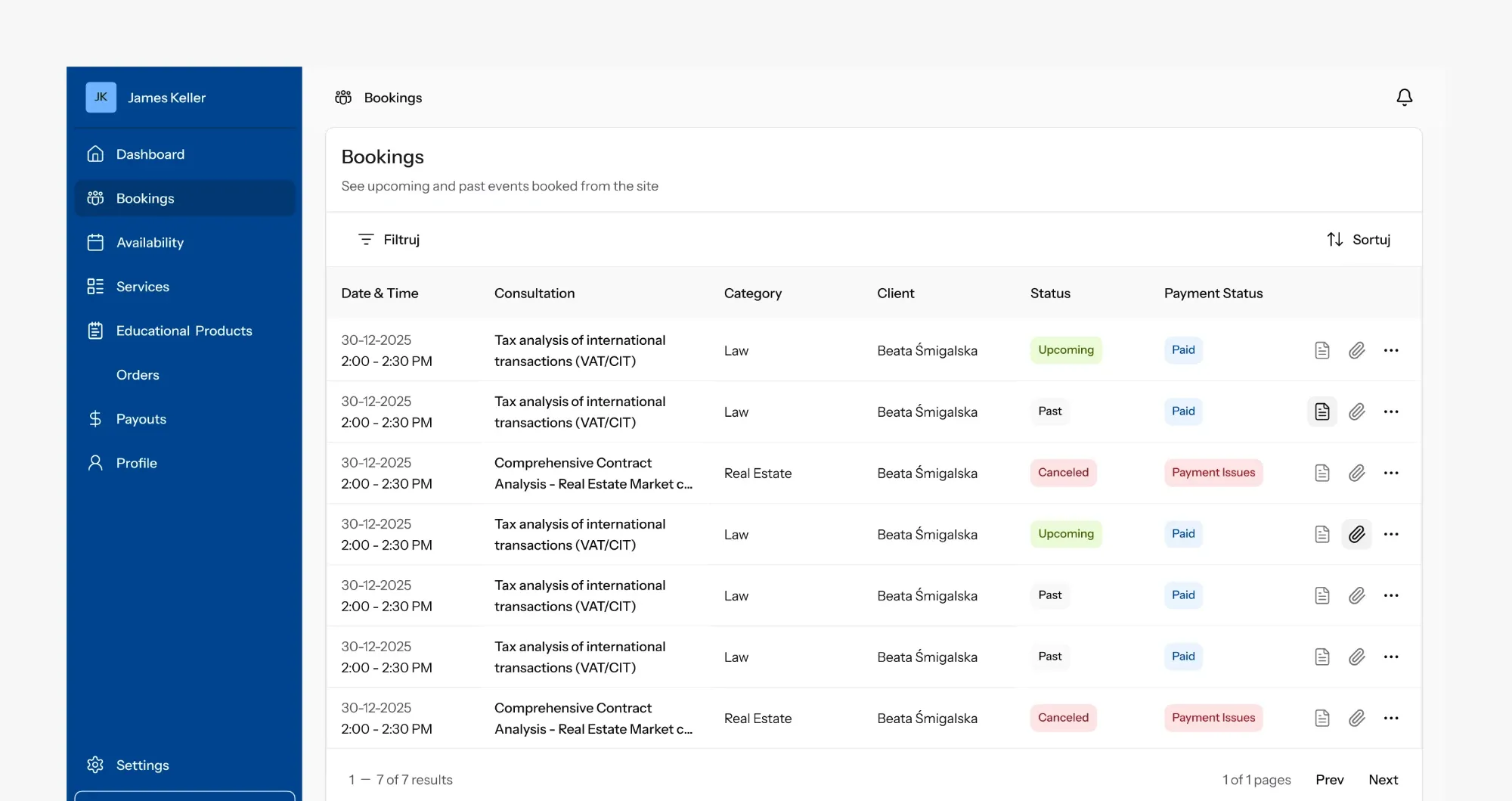
The 5% platform fee rides on Stripe Connect as an application fee, attached to the order it came from and to the advisor's connected account. Each payment is split at the point of charge: the platform fee is deducted, and the remainder is credited to the advisor's Stripe Connect Express account. The advisor dashboard carries the order amount, the fee, and the net sum available for payout.
Advisors complete Stripe's onboarding once and request payouts from their panel. An advisor can request the next payout 7 days after the previous one, enforced in the panel and in the API, with the unlock date shown on screen.
The Document tab holds each advisor's subscription and commission invoices, uploaded by the Montelink team, with an email going out when a new one lands.
Expert panel with certificate upload
Mercur's vendor panel was customized for Montelink's experts. Advisors handle their own onboarding, availability, and pricing, and can respond to client reviews. They upload certificates, which clients can open on the public profile before booking. A buyer choosing an advisor is buying trust first, and the platform gives them something to check.
Advisors are responsible for the accuracy of the qualifications and credentials they publish. Identity verification for payment onboarding is handled via Stripe Connect.
Platform notifications fire on advisor registration, subscription purchase, renewal, and cancellation. The operator learns about a change in supply without watching for it.
Consultation as a product
The catalogue already carried products of different kinds. What it didn't have was a booking priced by a prepaid time block plus any extra minutes, tied to a person's calendar and delivered over video. That product type was written for Montelink and sits alongside the webinars and e-books.
A free consultation takes the identical route. It is booked, scheduled, and delivered by the machinery that handles a paid one, which the payment provider does not offer by itself.
Two-way calendar sync
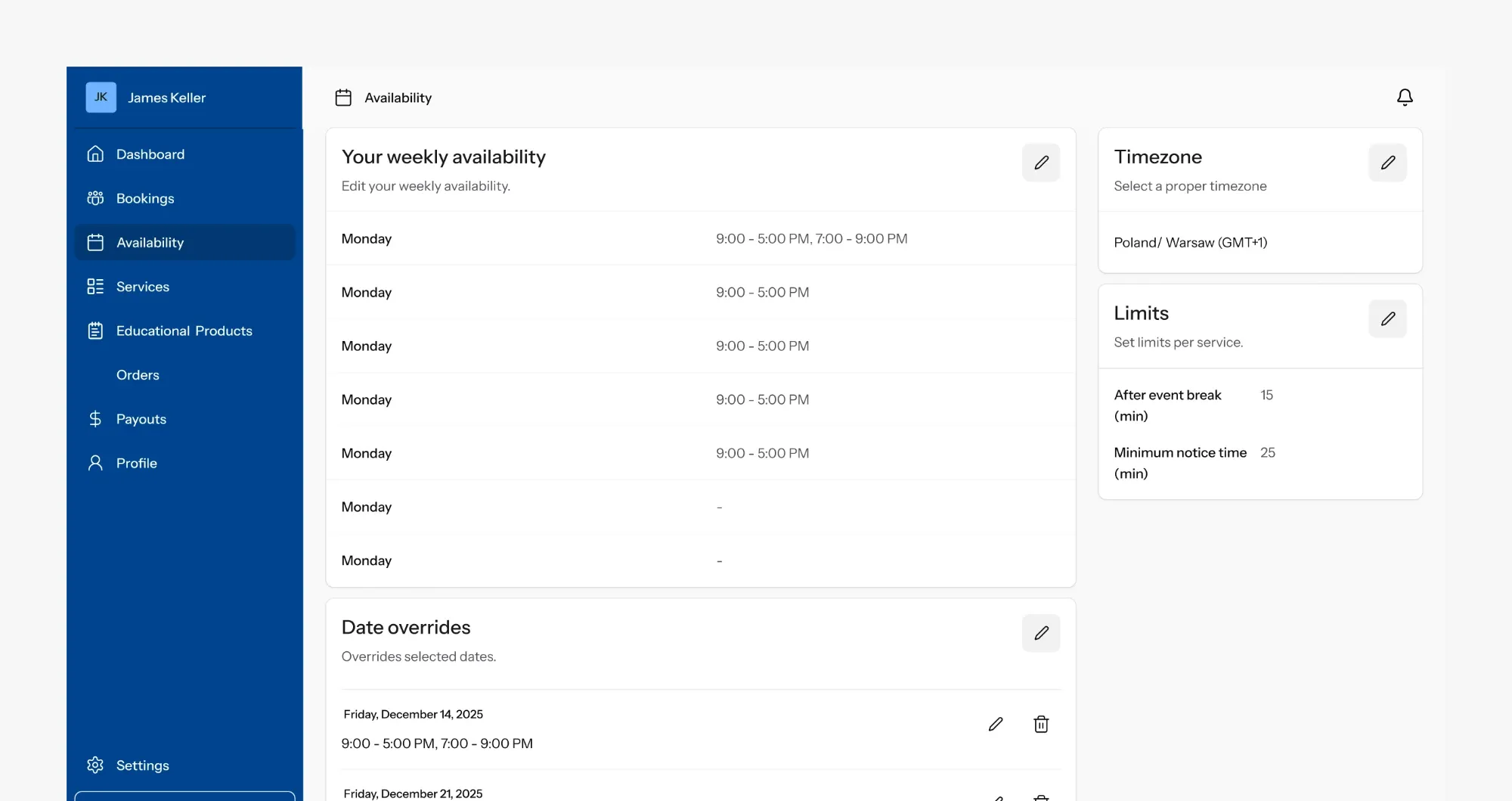
Availability moves in both directions between Montelink and the calendar an advisor already keeps. Commitments made outside the marketplace close the matching slots, and a booking taken on Montelink appears in their own week.
Clients only ever see slots that can be taken. The double booking that would cost Montelink two relationships at once never reaches the buyer.
Video sessions created by the platform
Booking a consultation creates the meeting itself. Both sides get a calendar invite, reminders go out before the start, and the meeting stays attached to the order it came from. The session log gives the billing engine a record of the consultation's duration.
AI-powered translations
Advisor profiles and platform copy are translated by AI. A new language arrives without an editor rewriting the catalogue, and the advisor writes their profile once.
Featured advisors and curated listings
Montelink chooses which profiles surface first in each category, and can promote individual advisors. Discovery on a marketplace of hundreds of individuals decides who earns. Holding that control gives Montelink a lever over supply, and a paid placement to sell later.
Subscription plans with usage limits
Advisors pay for platform access as a recurring plan, and the limits attached to each tier are enforced by the platform. VAT is added to each subscription based on the advisor's tax ID and country of registration.
What Mercur integrates with
- Stripe Connect (Express) - split payments and automated payouts, with each advisor as a sub-account under the platform's own account.
- Stripe Tax - VAT and the EU OSS scheme rated per sale, with the records needed for reporting.
- Stripe Billing - recurring charges behind the subscription plans.
- Zoom - meeting creation, calendar invites, and timed reminders.
- Google Calendar and Microsoft Outlook - two-way availability sync.
- DeepL API - machine translation of advisor profiles and platform content.
- AWS S3 - storage for certificates, invoices, and documents shared between clients and advisors.
- Railway - application hosting.
Results
Montelink now runs a marketplace shaped around how its business actually works. Advisors sell their own time, clients pay for the booked block plus any extra minutes the session runs, and the booking, the video session, and the payout are one flow.
New platform functionalities appear in front of buyers quickly, because developing the business means adding a module to it. And a new kind of product joins the same catalogue and inherits the cart, the checkout, and the order records already there.
Selling in one more country is a configuration pass. A region entry carries the country's currency and its tax treatment, the translation layer takes the content, and the storefront follows.
The marketplace layer underneath keeps improving while the part Montelink owns stays untouched.
Implemented by Rigby.
About working on Mercur


Mercur allowed us to direct our budget and time toward what differentiates Montelink in the market – the way we monetise experts’ time and serve clients across multiple jurisdictions – instead of rebuilding standard marketplace functionality. Solutions tailored to the advisory sector and to our client base now evolve at the pace set by market demand, not by technical constraints. The result is a platform that scales with the business and expands into new markets without the need to rebuild.
More case studies

Global B2B marketplace for reclaimed construction materials
Material Index lets contractors, architects and developers buy and sell reclaimed materials, live in the UK and licensed in Australia, the USA, and Spain.

B2B marketplace for private-label supplement manufacturing
Suplement.io equips supplement brands with EU-based manufacturing – ready-to-brand products, private-label formulation and compliance – in 20+ EU countries.
Ready to build?
See the product – open the demo, or book a walkthrough with our experts.